Create Your Own Start Line (New Year’s Resolutions are a social construct)

Why do we put so much pressure on ourselves to be something/someone better on January 1 than we were on December 31? I get the idea that we can treat the New Year as a new opportunity but if you think about it, it’s just as arbitrary as making next Wednesday the day you decide to start something new. I get the idea of needing a mental start line when you’re doing something new but I’ve never really understood New Year’s resolutions. Besides that, how well do they actually work? I don’t do behavioral research and honestly I’m feeling too lazy to look up the stats right now, but anecdotally most people drop their resolutions pretty quickly. New Year’s resolutions set people up to fail, and probably end up being discouraging. Why don’t they work? I think part of it is the arbitrary decision to change something without actually being ready to change. This is where behavioral research IS important and I did bother to look some things up for you.

screen shot 2019-01-20 at 6.36.35 pm

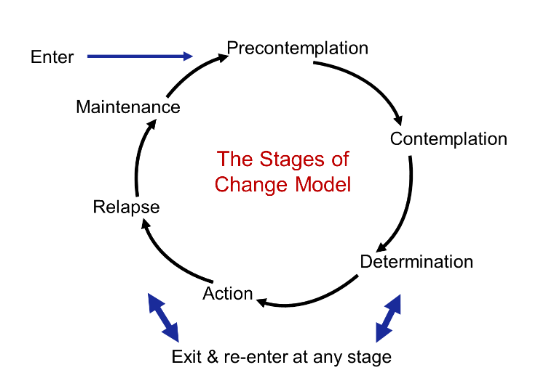
Schematic of the transtheoretical/stages of behavior change model

The readiness and ability to change behavior can be described by the stages of behavior change model.To summarize it, there are several stages that range from pre contemplation (you’re not even aware that you want to change something yet) to maintenance (you’ve made the change and maintained it for months). Depending on where you are mentally/emotionally in the stages, different interventions and strategies are useful to help you decide to change, how to do it, and how to maintain the change. One of the most important stages is action-actively making the changes necessary to reach a goal.

Ready, set….no.

Quit smoking! Lose weight! Start that exercise program! Society also puts tons of pressure on people to make lifestyle changes at the start of a new year, and there are lots of enticing specials on gyms and weight loss programs. These programs might be helpful for someone who’s ready for action, not so much for everyone else. The pressure of New Year’s resolutions force people in the earlier stages of behavior change to fast forward to action. This sets them up for failure from the very beginning. People don’t progress through the earlier stages and are not truly ready for change and are not fully committed-making the changes difficult to maintain, and they fail. Again, I don’t know the research on the effects of this, but it seems so counterproductive. I would bet that this failure pushes people even further away from truly being ready to change, delaying the point where they could actually be successful in the action stage.

If you really want to make a New Year’s resolution, your best option is to pick something you have wanted to change for a while (pre contemplation), have weighed the pros and cons of changing or not (contemplation), have already taken some minor steps towards making the change or are planning what those steps would be (preparation/determination), and use the New Year as the opportunity to implement the actions necessary to reach the goal.

If you really want to do something, why wait until the New Year? (aka My diet starts as soon as I finish eating this gallon of ice cream.)

Think of any time you really wanted to do something. Most likely you just did it. If that happens to coincide with January 1-great, but if not who cares? You can create your start line whenever you want, whenever you’re truly ready, and if it’s not on New Years you shouldn’t feel the least bit bad about it.

Endurance Sports and Existence

Endurance Sports and Existence
threshold

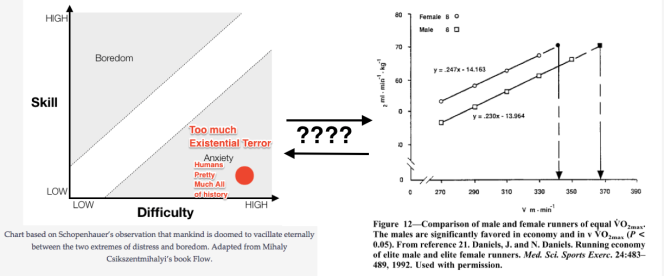
Is is a coincidence that figures describing existential terror and VO2 max look so similar? Maybe not.

The Endurance Sports Part

In endurance sports performance, there are 2 important variables related to aerobic capacity that determine performance; maximal oxygen consumption (VO2 max) and anaerobic/ventilatory/lactate threshold. VO2 max is the maximum amount of oxygen your body can consume during steady-state exercise. What this tells you in more practical terms is the greatest amount of energy your body can provide to your muscles to produce repetitive contractions. This energy to produce muscle contractions is an obvious requirement for movement, so the amount of energy your body can produce is one of the limiting factors in performance. The higher the VO2 max, the higher your theoretical intensity (read=running/biking/swimming speed) will be. But there is another limiting factor that makes this energy level theoretical for endurance performance: threshold.

You may have noticed that I used 3 different terms for threshold: anaerobic, ventilatory, and lactate. These terms are often used interchangeably, and while each specific threshold occurs at roughly the same time, they are not exactly the same thing. Generally speaking, below threshold you have a higher reliance on aerobic, oxygen-dependent metabolism, and above threshold you have a higher reliance on anaerobic metabolism. The specific differences between each type of threshold are not relevant to my larger point in this article, so if you’re interested I can get into that later. For now, I’ll just use “threshold” as a generic term.

While VO2 max is the limiting factor for energy production, threshold is what really sets the limit on performance. During endurance events (metabolically this is anything longer than ~3 minutes) our bodies rely heavily on aerobic metabolism. There are several reasons for this: exercise intensity, muscle fiber type, rate of energy usage, and availability of energy sources (blood glucose, free fatty acids, muscle glycogen and fat stores). Working at a level below threshold means your body is able to meet the metabolic demands of the exercise intensity while still relying mostly on aerobic metabolism, therefore allowing you to maintain the intensity. The higher your threshold as a percentage of VO2 max, the greater intensity (i.e., speed) you will be able to maintain. This why VO2 max is the theoretical maximal intensity, no one runs a marathon at max (I dare you to try) because threshold is what will truly determine your intensity during prolonged exercise.

While VO2 max and threshold are different things, they are not mutually exclusive. Generally, you can train to improve one and the other will be affected. Results may vary a bit based on fitness level and training mode; for the least fit doing ANYTHING helps EVERYTHING, when you’re already high level you have to be a little more specific. You don’t need to be an exercise scientist to know this though, the better shape you’re in the harder you have to work and if you’ve ever trained to improve performance you’ve experienced this. If you want to learn more about these concepts I highly recommend a review article by Basset, et al. which explains concepts related to performance quite eloquently, and is where that VO2 max figure came from.

Now that I’ve (somewhat) explained the science of thresholds in endurance sports, I can get to what I really wanted to talk about; existential max and threshold.

The Existence Part

I constantly find parallels between endurance sports training/racing and life. I like the physical challenge of long races, I like seeing how far I can push myself, and of course I like to get on the podium. Anyone who has properly prepared for a long race knows that the big deal is not really the race, it’s the weeks, months, or years spent training for it. It’s this part of it that keeps me coming back for more. I find that the time I spend training is when I really learn about myself. Maybe it’s all the hours I spend alone with my thoughts, maybe it’s the endorphins circulating in my brain, maybe it’s the pain tolerance I’ve had to develop to be able actually DO the training and racing. Maybe it’s all of them. Either way, the idea that the more you push yourself, the more you will be able to withstand has been presenting itself in more than just my training.

Most recently I’ve seen it in my academic career. I recently completed the second biggest step in my PhD, the comprehensive exam. I’ll spare you the mundane details of the test, but it takes about 3 months to complete the whole process and it’s extremely high pressure, high stress, and high consequences. If you don’t pass comps you have an opportunity to retake it, but if you don’t pass on the second go, you basically get kicked out. It sounds like the kind of thing that would make you lose sleep at night, and I can’t say that I wasn’t very stressed out during the process, but it wasn’t as bad as you’d think. How is this possible?

I think it’s because during winter/spring semester 2017 (WS 2017) I had the absolute worst 5 months. I took a 4-week winter class on my LEAST FAVORITE topic (Matlab programming) that led straight into a grueling semester that was loaded up with challenging classes. That semester I found a new level of discipline that got me up around 6 on most mornings, and from the first week of January to the end of the semester in May I worked every single day (including weekends) except for 5 days in March when I took a short spring break trip. The semester didn’t end that well and I was in a pretty deep hole mentally that took me until August to crawl out of. I can’t imagine having to go through a time like that again (please, please, no) but the benefit is that I’m so much better equipped to deal with insane workloads and the associated stress. That semester increased my workload and stress max for sure.

While WS 2017 increased my max, I think comps increased my threshold. The stress was intense, but I knew it was for a finite amount of time and once it was all done things would improve dramatically. Since comps wasn’t the worst academic situation I had been in I handled it much better, and sometimes I was even afraid people would think I wasn’t taking it seriously enough because I was not excessively stressed out about it-just normally stressed out, if that’s a thing. Things that seemed overwhelming before are now at least doable, and things that used to stress me out a lot are just business as usual. My threshold for what is academically difficult has been gradually increasing over the years, but comps really pushed me to a new level.
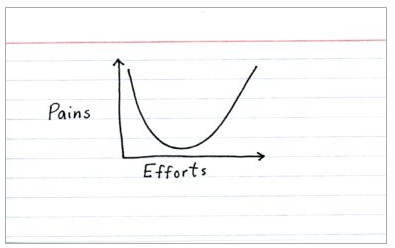
Screen Shot 2018-12-09 at 1.19.11 PMJessica Hagy draws it best.

If you want to increase your threshold by training, you have to do some truly grueling workouts. These workouts usually involve gasping for air, burning muscles, and lots of fatigue and pain (of the best kind, of course). The intensity is hard to maintain, hard to push through, and it takes a lot of determination not to give up in the middle. I usually dread these workouts, although I do feel extremely accomplished once they’re over. This also describes how I feel about the academic threshold I’ve finally reached. School has been grueling, painful, discouraging, and challenged me in ways that I never imagined it would or could. Finally though, I’m starting to feel that this process has made me smarter, stronger, and more capable.

Just like during the hardest workouts and the longest races, there have been so many times I wanted to quit. During these times I’ve asked myself: Why am I doing this to myself? What is the point of all this? Is it really necessary for me to suffer like this especially when it is all self-inflicted? My own rebuttals to these questions are what have kept me going. I’ll be stronger or smarter if I push through. The point is to become a better person. What is the long-term benefit you can focus on instead of the acute discomfort? How will you feel about yourself if you quit now?

If you want to increase your threshold it does not mean you have to kill yourself with a crazy training program or go get a PhD, but you DO have to get out of your comfort zone. Building up endurance and tolerance can and should be a gradual process, otherwise you’re likely to burn out or get overtrained, neither of which are productive. Start with small challenges and work your way up. The point is, the more you push yourself the further you are able to go. You may find that you are capable of things you never imagined, existential crisis not required.
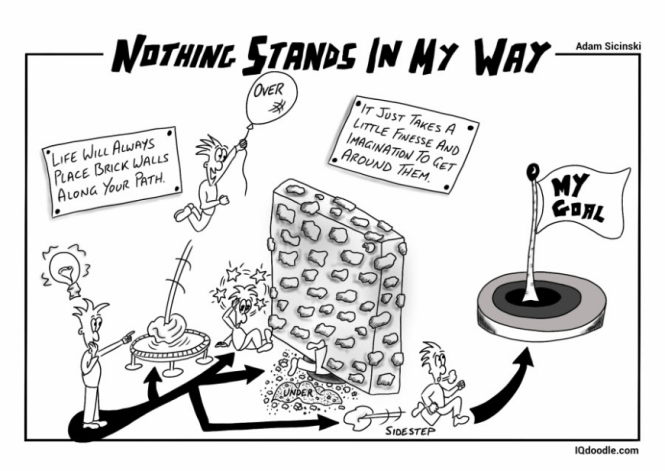
Screen Shot 2018-12-09 at 1.00.06 PMCredit for this cartoon is from here.

It’s all about the Cadence

If you’ve talked to me about how to improve your running at all lately, you already know that I’m obsessed with running cadence, aka step rate or step frequency. I’m not one to tell you that there is one BEST thing you can do for anything (see: it depends, see also: shit academics say, things undergrads complain about on their TA reviews). However, after reading a mountain of papers on running mechanics and injury, at this point I believe that cadence modification is
the one best thing runners in general can do to decrease their injury risk and improve performance.

Disclaimer: Ask me again in 1 year, 5 years, (also maybe 10 years?)…I might (probably will) change my mind.

What is the big deal about cadence? I’m so glad you asked!

What is it?

Cadence is simply how quickly you are stepping, measured by the number of steps per minute you take while walking or running. I’m particularly interested in running so everything from this point forward here will relate specifically to running.

Ideal cadence is around 180 steps per minute, which is equivalent to 90 strides per minute (steps: the number of times both feet hit the ground per minute vs. strides: only 1 foot). The graph below is from a study where they estimated optimal cadence at a set speed based on how runners performed at a variety of cadences at that speed, and as you can see it’s around 91 strides/min (182 steps/min) (de Ruiter, Verdijk, Werker, Zuidema, & de Haan, 2014).

Screen Shot 2018-11-15 at 9.09.17 AM

How can you measure it?

Garmin and Apple watches, FitBits, shoe pods of various sorts, and probably some other apps that I’ve never heard of can measure your cadence. The technology used to measure this (accelerometers) works great for this kind of measure because running is very repetitive, so devices do a good job of detecting when each step occurs. If you have a device that measures this for you, it’s probably quite
accurate and you can trust it. If you don’t have such a device, you can also easily count your steps for 15 seconds (counting both right and left), and multiply by 4. You could also count for a full minute, but I usually lose track and the 15-second count is close enough.

Why does it matter?

There are about 10 reasons why it matters, but let’s start with one of the most important ones: metabolic cost. Metabolic cost in running is measured by how much oxygen you consume to travel a distance. All aerobic activity costs you oxygen, and when it comes to running the less you “spend” per mile the better, because it means you can run faster and/or longer, or at least be less tired if you don’t change your speed or distance. Some would argue that being less efficient is better for caloric expenditure (spending more oxygen does mean burning more calories), but you could and should spend that oxygen on running faster or longer instead-mostly because of the injury risks associated with inefficient running form.

You know the fancy new Nike shoe that Kipchoge almost ran a 2-hour marathon in? Metabolic cost is the variable this shoe has been shown to improve, and Nike is banking on the idea that if each mile costs the runner less than before, he’ll be able to run faster. By the way it worked-he ran the Breaking2 marathon in 2:00:25 and his prior record was 2:03:05. You may not be trying to break any land speed records, but everyone can get on the self-improvement train and go for a PR. Even if you can afford $250 shoes to race in, and especially if you can’t, you can increase your step frequency to get a little bit faster.

In addition to efficiency, there are a host of injury-related variables that step frequency affects, and I’ll get to those soon. In the meantime, happy running!

Reference

de Ruiter, C. J., Verdijk, P. W. L., Werker, W., Zuidema, M.
J., & de Haan, A. (2014). Stride frequency in relation
to oxygen consumption in experienced and novice runners. European
Journal of Sport Science
, 14(3), 251–258.
https://doi.org/10.1080/17461391.2013.783627

Back in the Saddle (and pool, and running trail)

For the past 9 months, practically everyone who knows even the tiniest bit about me has been asking what I’m training for these days (because even the most casual acquaintance knows I’m a training/racing freak). Until last week the answer has been: nothing. To most triathletes, this means I’ve had nothing to live for! It is a weird answer for me to give considering that for the past 10 years I have trained for and completed in multiple races per year. So how did I decide that NOT racing was a good idea? Let’s go back to last year when I reached the height of my racing ambition at what turned out to be the most inopportune time. I’ve never planned out a full year program (because that sounds crazy, right?) but I’ve always performed quite well in my half-ironman races. I wanted to see what I could achieve if I really mapped it out. This led to a 36 week training program that started mid-January and took me all the way to September to a half-ironman race. The motivation! The challenge! The discipline! The color-coded spreadsheet! I had it all.

I also started what would turn out to be the most difficult, draining, challenging, and soul-crushing semester of my PhD program so far. The amount of work and discipline required to get through those classes was unbelievable. I survived but it went poorly and I had to do some extra work to do to truly finish all my classes. It wasn’t a great situation but it’s all resolved now, and I learned a lot academically and otherwise from it. In some ways, the ambitious training program helped-it made sure I exercised regularly, and physical activity is always good for stress and sleep. I had more than enough of one and not enough of the other even with the training so I shudder to think how much worse off I’d been without it. For the most part I did the training. I always consider 90% completion a pretty good success rate and although I haven’t calculated it I’m sure I was pretty close to that. I felt ready for the race, and even though I love training in general, I was getting a little discipline fatigued from such a long program and was glad to reach completion.

Depending on interpretation my race either went great or tragically. I had my best swim and run times EVER and had the fastest female bike time overall. Awesome! But I’m extremely competitive and I often podium at triathlons, and of course this was a main goal of my extra long training program. I got passed in the last 0.1 miles and got bumped from 3rd place AG. Needless to say my type A competitive side was more focused on this tragic disappointment than whatever improvements I made Let’s be honest, I still am *sigh*. I realize most people will roll their eyes at this and I understand, but the amount of time, stress, and discipline required to do that training to not fully achieve my goal was very disappointing and hit me harder than I’d rather admit.  I also felt like I was spreading myself a tad too thin…I was not reaching the level I wanted to in school or in racing and it seemed like I needed to pick. Why not just train casually and do a race in any old finish time? Well, I don’t really operate like that. If I’m going to do it I really want to give it my all and do my absolute best. It’s hard for me to just race for the hell of it.

This year I decided to focus my energy on school instead. Can you say “backfire”? Not to say that I haven’t done a lot of school work so far this year, but I’m not crushing it like I though I would. All those hours that I spent training are not necessarily going towards schoolwork right now. I’m definitely spending more time on school, but I’m missing some of the motivation and discipline that I have when I’m training too. For the summer I’ve decided on a happy medium. I planned out a program for an olympic race, but I’ll compete in a sprint. I have the structure and challenge of an intense program, but some leeway in case I have to skip workouts or cut them short because I have to prioritize something for school. It’ll help me keep my endurance up, but incorporate enough speed work to perform well in the sprint race. Most importantly, the program will give me something to structure my days around. I’m only 1 week in and I can already tell the difference, although I think it will take me a few weeks to get fully back into the training mentality again. It seems so obvious now, but I did not realize how ingrained training was to me. I’ve still been working out almost every day, but it’s just not the same as having my color-coded spreadsheet to fill in. I realize this isn’t for everyone, but having that accountability in writing-even if it’s just to myself- makes a world of difference. What makes the difference to you?

In Defense of Facts

It’s been too long. Summer “vacation” is here (I’m using the term vacation liberally here) and I’m trying to get back into some activities that I have been neglecting: training, leisure reading, and writing (here and manuscript writing). I hate to have to start off with this thing that’s been on my mind but I just can’t help myself.Quite some time ago I wrote a post (more of a rant, really) about how much Ashley Black pisses me off. To summarize, she made up her own field of fasciology, which to the educated world is just called anatomy, and uses this as propaganda to sell a tool that can be helpful when used moderately, but when used incorrectly is apparently quite harmful. She makes lots of unsubstantiated claims based on unsupported theories. I’m sure I’ve said this a million times, but as someone who has spent so many years learning how the body works saying that someone like her irritates me is an understatement.

Anyway, I received this email a few months ago:  We have reason to believe that this review page was created in collusion with various other sites, reviews, blogs and posts to defame and harass Ms. Black. Ms. Black has been threatened and targeted by a group of women as well as her ex husband. Her private information has been exposed, including her home address. Not only is the content defamatory, but it is also a violation of her privacy. She is harassed daily and has even received death threats. Fearing for her safety, it is imperative that we get these online publications removed. Your publication is very well known and respected. Please do not degrade your publication by being a part of this smear campaign. Please, for the sake of security we ask that you help us and kindly remove your article.

To be clear, my post has nothing to do with an organized campaign of harassment and defamation and if Ashley has been threatened physically or in any other way that’s not ok. I have no idea who her ex husband is, or whatever other sites/reviews, etc. are involved in this situation.  However, I will not take my post down. I understand if Ashley is worried about negative publicity. She is exaggerating what her device can/will do and fabricating scientific theories to back it up, and I have the right to criticize her for it. It’s one thing to make and sell a device and I have no problem with that. I do have a problem with her twisting the meaning of scientists’ work to support her propaganda, and trying to silence any criticism of it. It’s not like she’s the only fitness person to do this, but since I’m conducting real research on myofascial release I can’t help but take it a little personally.

After putting up the original post I was contacted by someone who used her device as recommended and whose skin completely detached from the underlying tissue. Why? Because the connective tissue that holds the skin to the stuff below it is the same tissue that causes the dimply look of cellulite when you get a lot of fat under your skin. So I guess her claims that her device gets rid of cellulite are technically true…but this is why I’m so critical of unsubstantiated claims. Sometimes the consequences of making things up are real, serious, and can permanently affect someone’s life and health. I think fitness professionals should be held to some higher education/certification standard to be called professionals. More education leads to better, safer practices, and although we’re not doctors shouldn’t we also first, do no harm?

It’s Just Like Riding a Bike

photo 1

While recently visiting my peeps in Miami, I attended a cycling class at a popular boutique indoor cycling studio. I’m extremely picky about instructors and workouts, but I’m training for my next triathlon and rather than skip my workout completely I prepared myself to do my own thing if I needed to because of whatever foolishness I would encounter in the class. I was hoping to be pleasantly surprised that the class would follow safety guidelines and that the drills would be effective, but that is not exactly how it went.

First of all, the instructor’s music was fantastic and her instructions were clear. The studio was clean, the class was crowded with good energy, and I really like the vibe of the place. The bikes each had a console that showed a numerical level of resistance, real-time RPMs, and power. Class started right on time, which is extra important for this class that was only 45 minutes. So far, so good.  Unfortunately there were several MAJOR problems with this class that had nothing to do with the instructor.

The RPMs on the bikes were flat out wrong. I spied on the people around me to see if it was just a malfunction on my bike, but no-all the consoles were reporting RPMs that were lower than actual by 20. This meant that at an RPM of 100 the console said 80, at 120 it reported 100, etc. This is a problem because you’ll work harder at higher resistance/lower RPMs and once you get above 120 RPM the risk of injury increases. With the lower reported RPMs you limit how high you crank up your resistance (you never get to actual 60 RPMs) so you don’t do as much work during the class. If you ever want to check your RPMs just count how many times one of feet hits the bottom of the pedal stroke for 15 seconds and you should count between 15 and 30 revolutions to be between 60 and 120 RPMs, which is the safety guideline for indoor cycling.  Another issue with the meter is the power level. Power is a work rate, usually watts, generally calculated by taking force x distance/time. You could calculate this in cycling by taking the resistance on the bike times the RPM, but this number would not accumulate. This is inherent in the calculation because RPM is revolutions/minute, a rate of speed. Yet somehow the power on the console was accumulating. I asked the instructor after class what the power units were. I had to explain my question (she didn’t really know what I meant, not a good sign) and she said it is the resistance x the RPM. If you’re paying attention, you’ll realize this doesn’t make sense. I just said thanks and left it at that. The other issues with the class are most likely a result of the brand of the studio. They incorporate weights into the workout. This is a huge NO for me because if you’re trying to do weights on a bike you are neither getting an effective strength workout nor effective cardio, combined with a fairly high risk of injury for your back. The instructor also did some interesting forward and back stuff on the bike which mostly just means you’re hanging on to the handlebars for dear life so you don’t fall off the back of the bike, (I almost wish someone would so they’d stop teaching this); and hovers, where you lock up your hips and upper body and only move the legs (burns a lot but stresses the back and falls into the ‘not that effective for strength nor cardio’ category).

I’ve heard people say that they like these classes because it’s the most effective way to get an overall workout. I would just like to ask, if you’re cycling why do you expect a “full body” workout? I understand the need for expediency and simplicity but unfortunately this kind of workout should not be it.  The next class I attended when I got back to Maryland was taught by one of my grad school friends in my department (shout out to Jen!) and it had all the things I look for-good music, good instructor, safe, effective. The best compliment I can give to another instructor is to keep going to their class and I’ve got Jen’s class on my calendar. Next time I visit Miami I’ll probably just go for an extra run.

Ashley Black Bullshit

If I see one more ad for Ashley Black Guru on my feed I’m going to scream. Her website describes her knowledge of fascia as “unique and proprietary”. She warns “fascia people” not to jump on her for saying many people have never heard of fascia. She uses scientific evidence to try to support her claims. She says that Academia is not interested in fascia (as if it’s one person). She says she’s studies fascia for 15 years, then tries to sell you a $90.00 tool.

Her knowledge is “unique and proprietary” because she makes assumptions based on theories meaning it is her imagination. Quite proprietary. Many people who don’t study exercise science haven’t heard of lots of anatomical terms. This means nothing. Academia IS interested in fascia. There are numerous studies describing detailed cadaveric dissections of fascial layers in different areas of the body, and an emerging body of research on the function of fascia as a supporting structure. By the way I’m in Academia and I’m studying fascia. She’s studied fascia for 15 years? Funny, I haven’t come across any published research with her name as an author.

There is a a lot of work to be done in this area of research and I’m not saying that many of the theories of fascial behavior won’t turn out to be true, but for now there is little to no evidence to show that they are.  As a responsible fitness professional and attempted academic, it is frustrating to fight the battle against irresponsible people like Ashley Black who exploit lack of knowledge and the slow pace and expense of providing real scientific evidence for a profit. If she really wanted to help you she’d actually study it, not just read articles other people write. Speaking of that, I’d better get back to the grant I’m writing to get funding for my foam roller study.

Define Health

Disclaimer: This is mostly my opinion, I haven’t done any research on this topic!

Since I’m studying kinesiology and my department is in the School of Public Health at Maryland, I spend a lot of time researching, thinking and talking about exercise and health. Because of a few conversations I’ve had lately, I’ve been thinking a lot about how to define health. Not surprisingly, different people think of health differently and I can’t help but think this could contribute to the drastic differences in the health of our population. Our knowledge and beliefs shape our actions which in turn affect our health, and this is where the definition begins for me. The dictionary definition of health is: the absence of illness or injury, or a person’s mental or physical condition. I’m not actually on board with that first part being THE definition of health, and I’ll get into that in a moment. There are several factors that I think are important in defining health.

Health Literacy

I hadn’t though about health literacy at all until I did a quick search for “health” on google and the first website that popped up (that wasn’t popular media crap) was the site for the Department of Health and Human Services. One of their main links is about health literacy, and I think this might actually be one of the most important factors contributing to health behaviors. Having knowledge or knowing how to find information about everything from how diet, exercise, sleep and stress affect your health to when and how to go to the doctor, and resources to help you make positive choices for all of these things are huge factors. Current knowledge in these areas must certainly affect individual behaviors. (How may people exercise because they know they should vs. really like it? Probably not enough…but I know there are a lot of people out there.)

The Absence of Illness or Injury

This one is also important, but here’s why I think it is incorrect to consider this the only definition of health. Many diseases/disorders, particularly chronic ones (cardiovascular/circulatory diseases, diabetes, Alzheimers, liver/kidney diseases, many cancers, etc.) develop over years and decades of poor dietary and/or exercise habits. One bad meal or missing one workout will not cause you to develop these diseases or even have much effect at all for that matter. However, years and years of poor diet, nutrition, excessive alcohol consumption and/or smoking will. Therefore, just because at a given moment in your life you are not diagnosed with a certain disease does not mean that your lifestyle is not negatively affecting your health in a very permanent but temporarily unmeasurable way. Once you have interrupted your body’s function enough to develop diabetes or have a heart attack, you may be able to reduce or eliminate the symptoms of these diseases, but these body systems will NEVER function completely normally again. Don’t forget that EVERYTHING IS CONNECTED so one symptom can lead to many diseases/conditions. (diabetes=kidney problems, neurological dysfunction/limb loss, blindness; Chron’s disease=osteoarthritis, cardiovascular disease).

Maintaining a Heathy Weight

I’m definitely on board with the current trend of accepting yourself for who you are, no matter what. I have to admit though I am a bit torn when it comes to obesity. I don’t intend to body shame anyone, I don’t think obese people should be ashamed of themselves, and I am extremely sympathetic to people struggling with obesity. I’ve read enough research on how obesity affects body system functions, and have trained enough ridiculously hard-working obese clients to recognize that obese people who are working to lose weight are fighting an uphill battle. For many people this has nothing to do with how much or little they are eating and exercising. That said, there are still risks involved in being overweight and obese and losing any amount of weight if you are in these categories will reduce your risk, and exercising and healthy eating will help even if you do not lose a substantial amount of weight.

In a perfect world (as if) people would just not become obese because like all diseases prevention is “easier” than treatment. By the way, not being overweight or obese does not mean everyone walking around should be a Skinny Minnie. At my height, my weight could range from 124-158.4 lbs and still be considered within a healthy range (I’m usually around 138). At 158 I would definitely not call myself skinny, but according to disease statistics I would still not be at a measurable increased risk of disease.

Having a Basic Physical Aptitude

Can you walk up 3 flights of stairs without having to take a break? Can you carry several grocery bags in each hand? Can you reach to the top shelf in your kitchen cabinet? Can you bend down to tie your shoes or pick something up off the floor? If you had to run away from or run after something could you run for 5 minutes? Can you mow your yard with a push mower and shovel snow without being exhausted or injured? Good enough-you don’t need to be in marathon shape to have basic physical aptitude.

Nutrition

This one is a little harder to define because different populations have different needs, and such a wide variety of foods could meet these needs. If you’re meeting the daily value for vitamins and minerals and meeting the macronutrient recommendations from food rather than supplements that’s a good start. Making sure you’re added sugar intake is as low as possible, and fruit and vegetable intake is high.  After thinking about this over the past several weeks, these are the factors that I think are most important to define health. If you think I missed anything or have any comments about what I described here I’d love to hear from you!

Swimming Thoughts in the Snow

P6060712.JPGWhile I’m buried under 2 feet of snow by winter storm Jonas, I’m dreaming of the days when I lived in Miami and got to complain about how anything under 70 was cold. I’m also really missing my outdoor pool where I swam year round, even on those frigid 60-something degree days! I haven’t done any triathlons or serious triathlon training since I moved north in August and I’m seriously missing it.  Considering the work I’ll have cut out for me to get back into the training routine, I’m most concerned about the swim. It’s my weakest event already and even though I’m still swimming here and there, nothing compares to the hard training I was doing even a year ago. The swim is the smallest portion of the entire race which is good for me, but I think the importance of swim performance is often downplayed. Yes, I can still perform very well overall although I am very middle-of-the-pack on the swim, but think about how much better I’d do if I was even in the top 25%! Lots of studies measured how cycling affects running, but not as much attention is paid to swimming.

I came across an article that reviewed how the swim affects the cycle portion of tris, and some even looked at its effects on both the bike and run legs.  Here is a summary of some of the findings. I’ve put the major points in bold if you’re a skimmer, and more details if you want the nitty-gritty. For you scientists, here’s a link to the full article here.

Swimming causes a decrease in cycling power output.

The details: Triathletes swam 800m (basically, sprint distance) in an average of 10min, 24sec. Then they cycled for 75 minutes at 70% of their maximum heart rate and compared it to a cycling only trial at the same intensity. Their power output after swimming was 17% lower, meaning that at the same relative intensity (HR) they would take longer to complete a set distance.

Longer swims affect cycling performance LESS than shorter swims.

The details: Triathletes completed a 3000m swim in an average of 52.5 minutes, followed by a 3 hour cycle. There was no significant difference in the power output, heart rate response, or blood lactate buildup when compared to those who only cycled. This may or may not be good news for longer distance triathletes since the swim distance is smack in the middle of half- and full-ironman swim distances.

Swimming increases physiological difficulty of cycling.

The details: Triathletes swam 1500m in an average of 30 minutes followed by 30 minutes of cycling, compared to cycling only. Although their performance was not shown to be affected (distance covered in a given time or power output), other variables indicated that cycling was more physiologically taxing. Heart rate, blood lactate, and oxygen consumption were all higher after swimming-all of which could negatively affect subsequent running.

Swimming at 80-95% is better than swimming at 100% for race performance.

The details: Triathletes did three different test days where they swam at all three intensities (based on a 750m time trial), cycled 20k, and ran a 5k. Cycling power output was much lower after swimming at 100% (278W compared to 298W and 305W). Run time after the 100% intensity swim was an average of 1:45 longer when compared to 80-85% intensity. No 5k time difference was given for the “moderate” intensity and I would’ve liked to know it. I like this study the best because they used real triathlon distances (why WOULDN’T you?!) and compared to both biking and running.

Improve swim performance, learn how to draft, wear a wetsuit whenever possible!

These findings show us that swimming does affect cycling, especially in short distances, and if you go balls to the wall during the swim you are likely to negatively affect your overall race performance. Improving maximal swim ability can help you improve your speed at relatively lower intensities, but as anyone who does this knows that takes FOREVER. The study includes some information about how drafting, wetsuits, and speed suits affect swimming performance but they don’t compare it cycling which is why I’m not detailing it here. They tell you what you you probably already know-that all three of these things help you swim faster without wearing yourself out more, which will help everything else.

Summary

Only one of the studies reviewed used actual triathlon distances. This is a pet peeve of mine in sports research because it makes it hard to translate the research to training when things don’t match up, but it still helps you get an idea of what’s going on. The athletes’ performance level also probably vary quite a bit. Some of the reviewed studies used absolute time, some relative intensity-so it’s hard to know exactly how you’d compare. But again, it still help you get an idea how your pacing strategy can affect your race.  Happy training!

Let me take a selfie

When it comes to marketing and exposure there’s no doubt that social media outlets including Facebook, Instagram and YouTube are invaluable to fitness professionals. You can reach an incredibly large and diverse market, and communicate all kinds of information quickly and effectively. Obviously I utilize these resources through my occasional blogging and Facebook posting and my recent YouTube adventures. It has been suggested to me by multiple that I should open an Instagram account but I just can’t bring myself to do it, and here’s why.

It seems to me that how many followers a person has on Instagram is being confused for credibility and knowledge as a fitness professional. Looking good and taking good pictures, posting the right motivational quote, snapping pics of your salad…I don’t have a problem with trainers and fitness instructors doing this to demonstrate what it takes to live a healthy and fit lifestyle. I know as well as anyone that it takes a lot of work. But this is not the same thing as being educated, knowledgeable, certified, and being able to teach safe class or train an individual on their specific needs and goals. Sure, you can have both a popular Instagram account and be well educated and good at your job, but unfortunately this is not always the case. I work out with one of my clients in the gym in his building. A couple weeks ago there was a girl in there who I will admit had a pretty great looking body-slim, toned muscles, low body fat (I’m not into the fake boobs and her ass was also questionable…but that’s Miami). Nothing she did in the gym explained in any way how she looks like that because in the 30 minutes that I saw her working out she didn’t do a single exercise that was worth a damn. Then she spent the last 20 minutes of her time in the gym attempting to take the perfect selfie. This place is like a funhouse of mirrors and she tried all of them. I’m making an assumption that the pic was for Instagram and I could be wrong, but nonetheless she demonstrates a population of fitness bloggers or Instagram “models” that I see all the time. They look good, so whatever they’re doing is working well for them, but when they get clients with extremely different capabilities and needs, they are doing things that are totally inappropriate for that person.

An example of how Instagram looks nice, but can be as real as reality TV, is a former student of mine who also has many Instagram followers. His page is covered with pictures and videos at the track at Flamingo Park, workouts on the beach, more stuff about the beach lifestyle, beach, beach, beach…the guy lives in Hialeah. For non-Miami people, Hialeah is nowhere near the beach. I will give the guy credit that he has his degree in Exercise Physiology, but let’s just say he wasn’t my top student. And a manager at a local training facility refused to hire him. So at least he’s not completely clueless, but he’s not that great, and his Instagram posts are BS. Sure, everyone knows how to work a pair of scissors, but that doesn’t make you a hairdresser. You have to go to school and obtain a license from the state before you can say that. So just because you can pick up a dumbbell, does that mean you know how to design a fitness program for someone? I don’t think so. What happens if you give someone a terrible haircut? They’re pissed, then their hair grows back. But what if you’re an uneducated trainer and you push someone to the point of rhabdomyolysis? Best case scenario they go into kidney failure, worst case scenario they die. I realize that sounds a little apocalyptic, but it’s happening more are more. I’m not saying that I believe if someone is on Instagram and has a lot of followers that they automatically don’t actually know anything. I just want to encourage people to be more aware of the true qualifications of the people they choose to get their information from.

Does the person have formal education in an exercise related field? What certifications do they have and are they high quality? What kind of work experience do they have? In addition to being what many people consider a hobby, exercise is a burgeoning field of science with an increasing population of highly educated and effective people studying and working to improve the health and well-being of the general population. Wouldn’t you rather get your tips from one of them? This is how I have chosen to set myself apart. I don’t do gimmicky short-term challenges, I don’t sell myself out with cheezy pictures of every workout I do because honestly there are too many. I have spent years of my life, tens of thousands of dollars, blood, sweat, and tears to read, study, practice and teach as much of what I know as possible. So, thank you to those of you that have shown me how much you value me, my knowledge and my experience by being my real-life followers in class and in training. A picture may be worth a thousand words but in this case I’d rather help you in person.